
Can You Actually Make Vibe Coding? I Built an App to Find Out
(Plus 7 Side Hustle Ideas for New Coders)
Forget hiring expensive developers.
You no longer need to spend months learning syntax before you can build something valuable.
Vibe coding — using AI tools like Bolt, Cursor or Replit to handle the heavy lifting — means that if you can articulate a problem, you can build a solution.
But…
Can you actually make money with these apps?
To find out, I decided to put Replit to the test. I built a fully functional app to track my stock market trades, and in this article, I’m going to break down exactly how I did it.
I’m also going to share seven specific app ideas you can build right now that have real monetization potential.
7 Micro-SaaS Ideas You Can Build Vibe Coding
Before we look at my build, here are 7 app concepts that solve specific problems. You could build these as subscription services, one-off tools, or lead magnets.
1. The Local Lead Qualifier
Target: Marketing Agencies Build a scraper that scans Google Maps for specific niches (e.g., dentists, plumbers) in a local area. The app checks their websites for “low-hanging fruit” — like missing Facebook pixels, bad mobile optimization, or slow load times.
The Value: It packages this data into a PDF report that agencies can use for cold outreach.
2. HR Onboarding Slackbot
Target: Growing Companies Companies upload their internal training documents (PDFs, docs) into your app. The app converts this data into a knowledgeable Slackbot.
The Value: New hires can query the bot (“How do I request time off?”) instead of pestering HR, saving everyone time.
3. Reputation Defender
Target: Small Business Owners An automated monitor that scans Google and Yelp every few minutes for 1-star reviews. When a bad review hits, it SMS texts the business owner immediately with an AI-generated, diplomatic response.
The Value: Speed is everything in reputation management. You sell this as a monthly subscription.
4. Airbnb Arbitrage Scanner
Target: Real Estate Investors An app that compares long-term rental prices (standard leases) against short-term rental data (Airbnb/VRBO) in the same zip code.
The Value: It highlights the “arbitrage gap” — properties where the rent is low enough to make a profit by subletting on Airbnb. Sell access to the dashboard or a weekly newsletter.
5. Influencer Audit Tool
Target: E-commerce Brands Brands waste millions on influencers with fake followers. This app scans social profiles to analyze engagement ratios, account age, and comment quality.
The Value: A “Safety Score” report that brands buy before signing a contract with an influencer.
6. Expired Domain Hunter
Target: SEO Agencies SEO pros love old domains with history and backlinks. This app scans for domains expiring in the next 24 hours, checks their domain authority, and flags the gems.
The Value: A daily email alert service for domain flippers and SEOs.
7. Dream & Tarot Visualizer
Target: Consumer App Store (B2C) A fun, “freemium” entertainment app. Users describe a dream or pick a card, and the AI interprets the meaning and generates a unique daily image representing it.
The Value: Simple ad revenue or a small subscription for “premium” interpretations.
Case Study: Building “The Wheelhouse”
Ideas are great, but execution is what matters. To prove this workflow, I solved a personal problem.
I trade stock options using Interactive Brokers. It’s a powerful platform, but the reporting is terrible. It outputs my trading data as a painful, messy CSV file. I wanted a clean dashboard to visualize my profits, losses, and premiums.
So, I built “The Wheelhouse.” Here is the exact process I used.
Step 1: The PRD (Product Requirements Document)
Do not skip this. I didn’t just start coding; I started chatting with Google Gemini.
I told Gemini my problem (“I have a messy CSV and I want a dashboard”) and asked it to write a PRD. This document outlines exactly what features the app needs before a single line of code is written.
Pro Tip: Your AI developer (Replit) is only as good as your instructions. Spending 15 minutes refining your PRD with Gemini saves you hours of debugging later.
Step 2: Design First, Build Second
Once I had the PRD, I went to Replit. But I didn’t go to the “Build” tab — I went to the Design Chat Interface.
Replit allows you to iterate on the visuals before writing the logic. I uploaded screenshots of other dashboards I liked and asked Replit to create a UI based on my PRD. We went back and forth until the buttons, charts, and layout looked perfect.
Only then did I click “Convert to App.”
Step 3: Iteration & Vibe Coding
The initial build took about 15 minutes. Then, I spent an hour “vibe coding” — just chatting with Replit to refine things.
I reminded it to ensure the CSV upload feature worked correctly.
I added Live Stock Prices (a feature I thought of mid-build).
I added filters to toggle between different trading accounts.
I tested everything in real-time using the preview pane on the right side of the screen.
Step 4: Deployment
Usually, I deploy to GitHub and Render to save money. But since this was a personal tool, I deployed it directly on Replit for $20/month. It handles the login authentication and hosting seamlessly, which was worth the cost for the time saved.
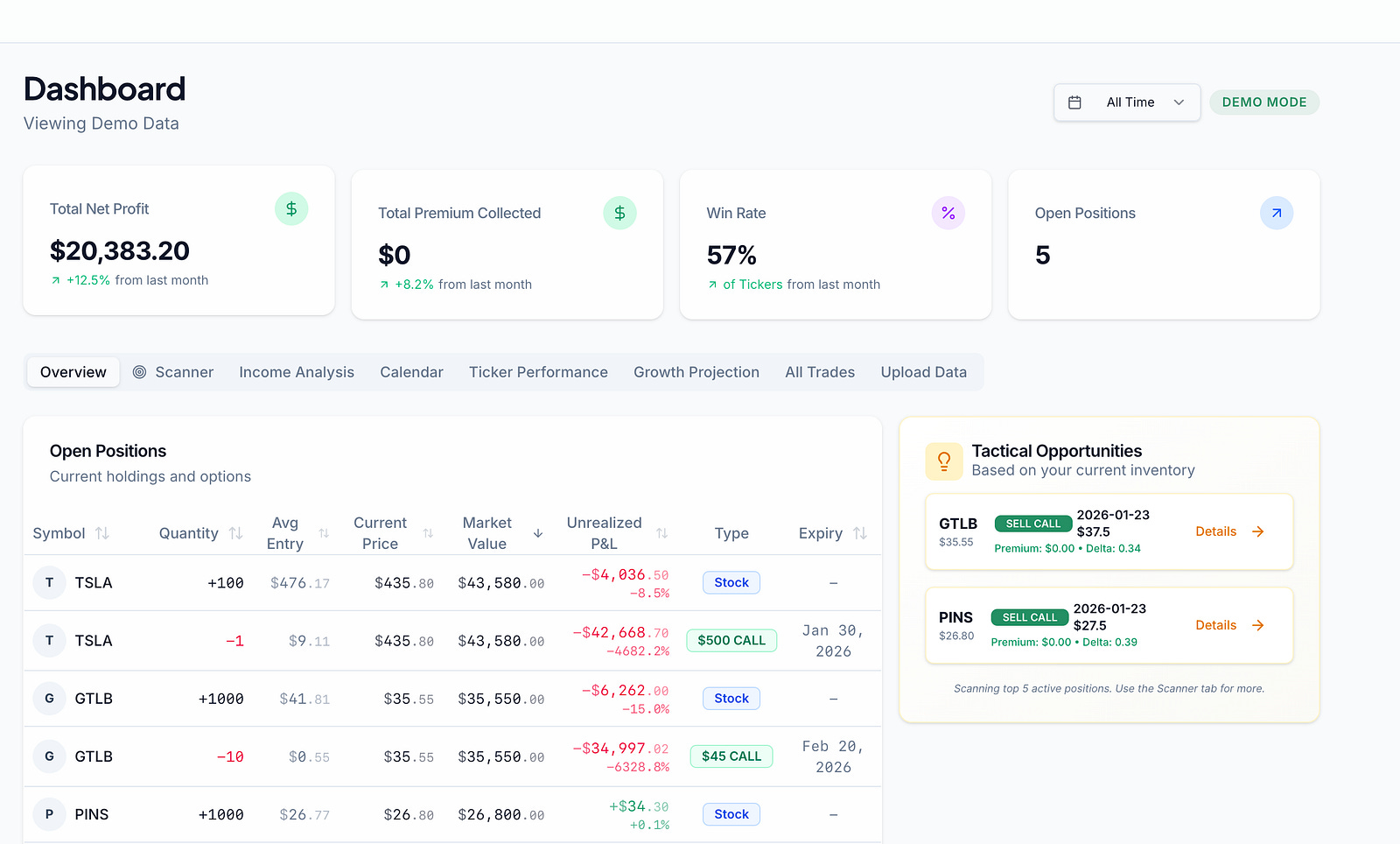
The Result: Inside “The Wheelhouse”
After about two hours of work, I had a tool that would have cost thousands of dollars to develop professionally a few years ago. It’s also helped me new a few k in extra premium each month.
(I’ve no plans to sell this tool just yet)
Dashboard: I can see my total net profit, win rate, and premium collected at a glance.
Income Analysis: A deep dive into monthly performance.
Growth Projection: I included a calculator where I can input my starting capital and target weekly return (e.g., 0.5%) to simulate compound interest over 1–4 years.
Ticker Performance: I can see exactly which stocks are making me money and which are dragging me down.
The Takeaway
Whether you are building a SaaS to sell or a tool to manage your own life, the barrier to entry has never been lower.
If you want to try this yourself, follow this formula:
Identify a specific data problem (messy CSVs, hidden data on Google Maps, etc.).
Spend 30 minutes crafting a detailed PRD with an LLM like Gemini or ChatGPT.
Use Replit’s Design mode first to nail the UI.
Iterate and Deploy.
You might just build the next big micro-SaaS, or at the very least, save yourself a massive headache.
Struggling to use AI without losing your voice? Get my pack of 101 Proven AI writing prompts. 🤖 Download it free here.